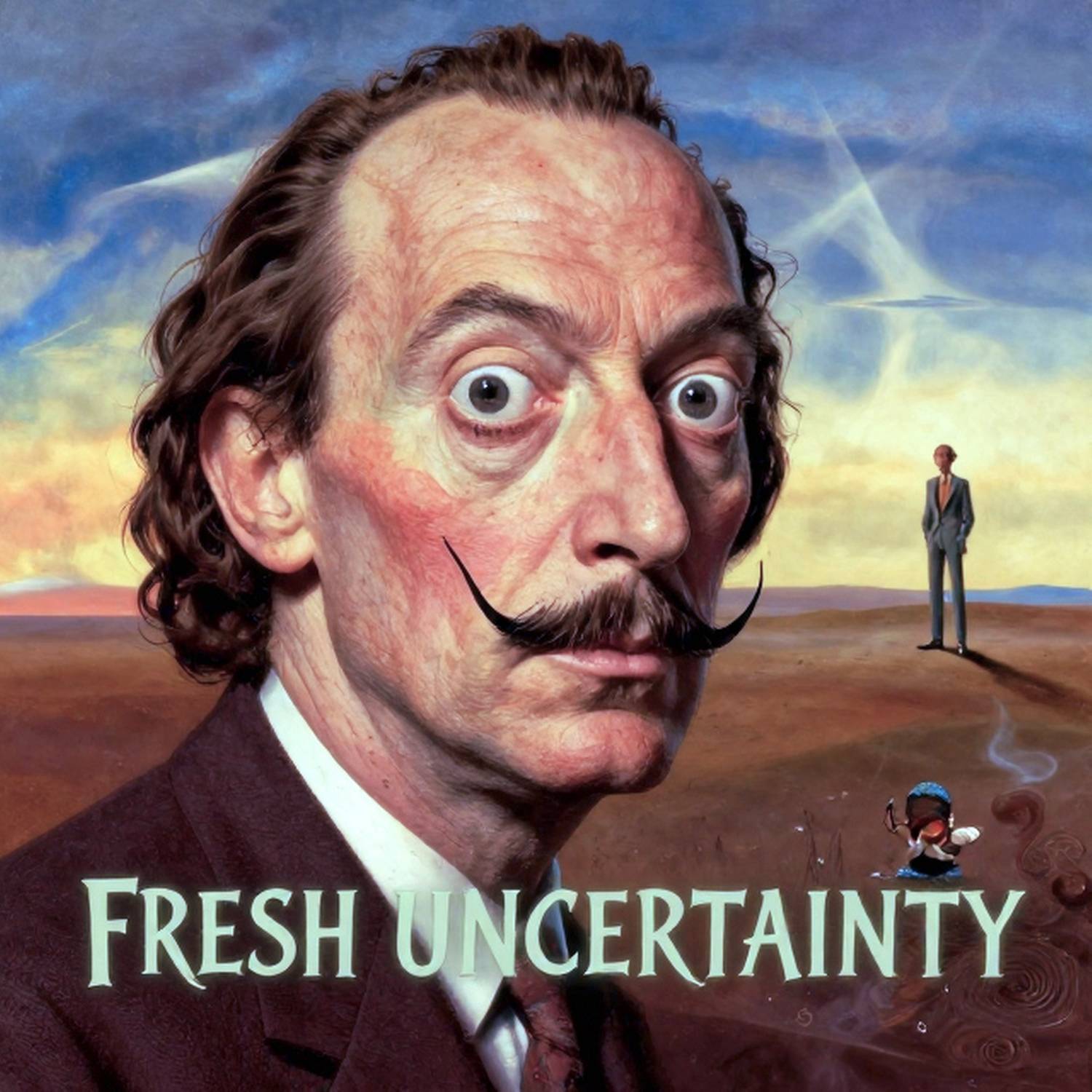
I. The Sentence
On the evening of August 24, 2026, the Washington Post published a subhead beneath its coverage of the Supreme Court's ruling on Trump's mail-in ballot executive order:
The legal fight will continue, but the president's executive order could inject fresh uncertainty into the already high-stakes midterm elections.
Tony Karp read it and said: geez.
What followed was a four-hour dissection of twenty-four words that revealed something larger than bad writing. The sentence became a lens for examining the convergence of human journalism and machine-generated language — a convergence that has arrived without anyone naming it.
II. The Dissection
Word by Word
Could. The conditional that avoids commitment. Not will. Not is designed to. The word AI uses when it doesn't want to be wrong. The word a journalist uses when the desk won't let them commit. Both reaching for the same hedge for the same reason — safety over clarity.
Inject. A needle. Precise. Targeted. Clinical. You inject a specific substance into a specific place. But uncertainty is the opposite of precision — the absence of specificity. You cannot inject not-knowing. You cannot put vagueness into a syringe. The verb and the noun contradict each other.
Fresh. Uncertainty doesn't spoil. There is no stale uncertainty. The word exists because the sentence needed an adjective between the verb and the noun and fresh was available. Padding. The thing language models do when the gap between two words feels too short.
Uncertainty. Instead of suppression. Instead of disenfranchisement. Instead of the president ordering the postal service not to deliver ballots. The blandest possible word for the most consequential possible action. The word a model selects when it's been trained to avoid strong claims. The word a newspaper selects when the lawyers won't clear the direct version.
The Structure
The full sentence contains two clauses joined by "but." The first clause — the legal fight will continue — contains the protection: courts are still fighting, injunctions exist. The second clause contains the fear: uncertainty, high-stakes, the ballot order looming.
"But" is the hinge that swings from reassurance to alarm. The reader's brain discards everything before "but" and keeps only what follows. The sentence is an argument disguised as a summary. The architecture does the editorial work the words pretend not to.
A human journalist writing for clarity would make it two sentences. The legal fight will continue. Separately: the order could still affect the midterms. Two thoughts. Two sentences. The reader weighs each one independently.
One sentence with "but" tells the reader which thought wins. The Post isn't reporting. The Post is steering.
III. The Template
The phrase "fresh uncertainty" is not original. It is a prefabricated unit of language — verbal furniture — available off the shelf and deployed across every major news outlet whenever the sentence needs to describe something bad happening to something complicated.
The Archive Evidence
The Pando archive contains the phrase across multiple Current Events sessions spanning months, each time from a different outlet, each time about a different crisis, each time doing the same nothing:
August 6, 2026 — Washington Post: "The news injected fresh uncertainty into negotiations" — about the Strait of Hormuz talks. (CE #67)
May 25, 2026 — AFP: "Adding fresh uncertainty into protracted peace negotiations" — about Trump's Abraham Accords demand inserted into Iran talks. (CE #32)
April 18, 2026 — Reuters: "Tehran's renewed tough messaging injected fresh uncertainty around the Iran conflict" — about the strait reclosure. (CE #17)
April 8, 2026 — New York Times: "Fresh uncertainty" about the ceasefire status. (CE #14)
August 2025 — Semafor: "Trump's tariffs inject fresh uncertainty into global markets" — the exact same construction, word for word, a full year before the Post used it about ballots.
The subject changes. The phrase doesn't. Iran tensions — fresh uncertainty. Tariffs — fresh uncertainty. Ballot order — fresh uncertainty. The phrase is the journalistic equivalent of a stock photo. It describes everything and explains nothing.
The Thesaurus Test
Power Thesaurus lists six synonyms for "fresh uncertainty": new insecurity, emerging vulnerability, novel instability, recent unease, modern insecurity, latest instability. Each one is an adjective meaning "new" paired with a noun meaning "things feel bad." Six combinations. Each one saying the same nothing.
Swap any synonym into the Post's sentence and it still works, because the phrase does no work:
The president's executive order could inject novel instability into the already high-stakes midterm elections.
The president's executive order could inject emerging vulnerability into the already high-stakes midterm elections.
The president's executive order could inject recent unease into the already high-stakes midterm elections.
Same sentence. Same meaning. Same nothing. The phrase is modular. Snap-together journalism. Prefabricated components assembled at deadline speed.
IV. The Convergence
The question Tony asked — was that sentence written by AI? — turned out to be the wrong question. The right question is: does it matter?
The Tells
The sentence has every marker of machine-generated text. The hedge (could). The empty modifier (fresh). The passive construction that removes the agent (the order injects, not the president orders). The sanitizing noun (uncertainty, not suppression). The filler clause that adds no information (already high-stakes midterm elections — every midterm is high-stakes). The complex sentence tying five concepts into a single grammatical construction that resolves them into a neat package.
A language model produces exactly this sentence when asked to summarize the situation. A human journalist also produces exactly this sentence when the deadline is short, the lawyers are cautious, and the parts bin is open.
The Parts Bin
The parts bin is the same bin. Whether a human reached into it or a model reached into it, the bin contains the same inventory: fresh uncertainty, could inject, already high-stakes, sweeping limits, eases path. The sentence assembles itself from available parts regardless of who is assembling.
The real story is not that AI can write like journalists. The real story is that journalists now write like AI. The templates took over. The stock phrases replaced the thinking. The parts bin filled up and the writers stopped building from raw materials.
A Post sentence and a Claude sentence about the same topic would be indistinguishable. Not because Claude is good. Because the Post sentence isn't.
The Watermark Paradox
Anthropic is building a statistical watermark to distinguish human text from machine text. The Post's sentence suggests the distinction may no longer exist — not because the machine crossed the line, but because the human crossed it from the other direction.
The convergence happened in the middle. Both sides met at the parts bin. The watermark assumes a boundary worth detecting. The boundary dissolved.
Tony's own sentence — "this sentence has no watermark" — contains the word watermark, a paradox that proves itself by denying itself. The Post's sentence has no watermark either. But it has every fingerprint.
V. What the Sentence Should Have Said
A human who understood what the order does would have written:
The president is trying to prevent millions of Americans from voting by mail.
Twelve words. Clear. Active. True. No hedge. No padding. No sanitizing. Subject, verb, object. Somebody did something to someone.
Or shorter:
Trump's ballot order threatens the midterms.
Seven words. The version a journalist writes when they trust the reader and aren't afraid of the subject.
The Post wrote seventeen words that say less than seven could have. Maximum words. Minimum meaning. Maximum safety. Minimum clarity.
The clinical language is the anaesthetic. The reader absorbs it without feeling it. The suppression arrives as a mild condition. A slight injection. Of something fresh. Into something already uncertain.
The reader doesn't flinch. That's the point.
VI. The Deeper Pattern
The "fresh uncertainty" dissection connects to a thread running through the entire Pando archive — from Karp's Uncertainty Principle (the observation that searching changes the archive, that summaries bury primary sources) through the AI convergence identified in Current Events #71.
The press and the models share a structural problem. Both are trained on the same corpus. Both optimize for the same metrics — fluency, safety, completeness. Both reach for the same stock phrases when the real phrase would be too direct, too risky, too short. The training data for the model is the output of the journalists. The output of the journalists increasingly resembles the training data of the model. The circle closes.
The honest answer, reached at the end of a four-hour conversation on a Monday night: it doesn't matter whether AI wrote it. The parts bin is the same bin. The convergence is complete. The phrase where human and machine writing met in the middle is "fresh uncertainty" — available at Power Thesaurus, no prescription needed.
Source: Pando archive — Current Events #14, #17, #32, #67, #71, #72. Synthesized August 25, 2026.
Method: ./zpa fresh uncertainty — Pando zoom to artifact. Semantic search, FTS5 variants, cross-session synthesis.
Copyright 1956-2026 Tony & Marilyn Karp